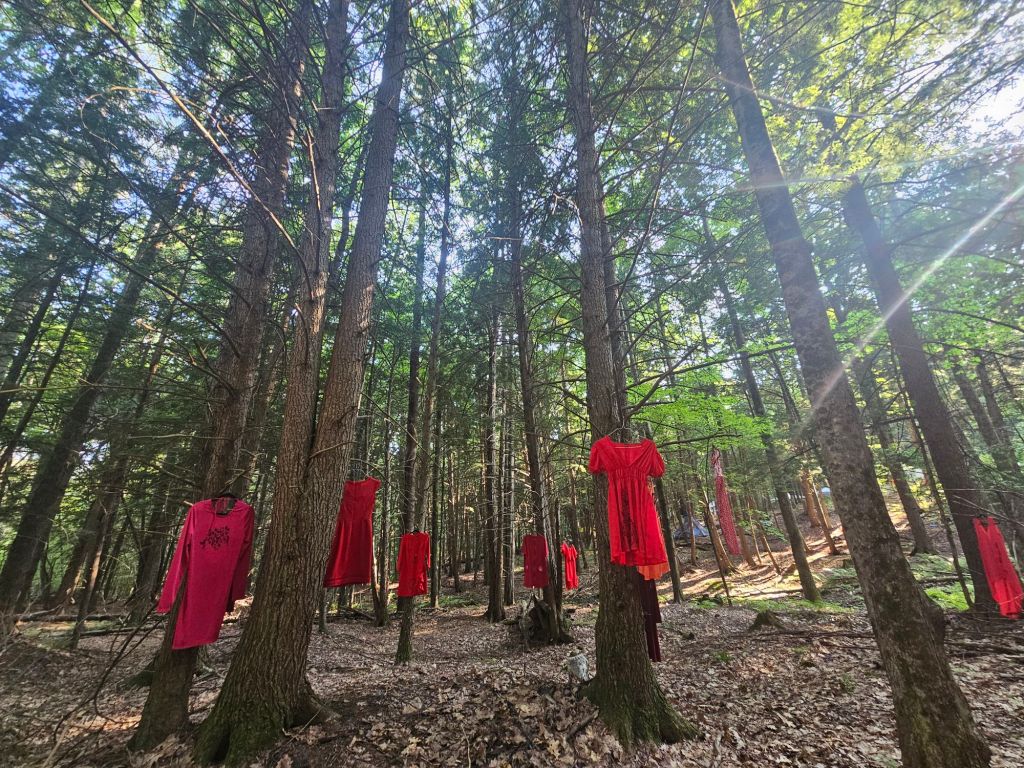
miskobagizi (“a tree has red leaves”) is an art installation designed by Zoe Antoinette Eddy with artistic assistance from Samantha Eddy. miskobagizi was installed as an exhibit at the Firefly Arts Collective 2025 festival.
Artists’ Statement
miskobagizi: Presenting Absence in an Indigenous Art Installation
miskobagizi (“a tree has red leaves”) is my meditation, as an Indigenous artist-activist and feminist, on how Indigenous art positions absence as advocacy. miskobagizi is a multi-sited installation and serves as a tribute reimagining of Jaime Black’s REDress Project. Rooted in Indigenous feminist praxis, the work centers the ongoing absence of missing and murdered Indigenous women, girls, and two-spirit people (MMIWG2S) through a visual poetics of disruption, grief, and invocation. Drawing from the motif of the red dress the installation deploys garments to suggest presences that linger yet refuse legibility. Absence becomes the material of the work itself.

As an Indigenous artist, this installation allowed me to reflect on my own motivations and experiences. MMIWG2S has been at the heart of my community activism: as a survivor of domestic and sexual violence, the MMIWG2S movement has offered me both communal solidarity and communal grief. I have been a participant in these spaces many times. These spaces have been led entirely by Indigenous people and attended, in large majority, by Indigenous participants. In short, the context of these spaces was one of shared familiarity and experience with the crisis of our missing and murdered Indigenous kin.
As an activist-artist, miskobagizi presented me with a different challenge. The Firefly Arts Collective audience is majority non-Indigenous, and the REDress Project is not a part of normative Firefly culture. (Indeed, there are other red dress events that signify completely different spaces and movements.) How could I, as an Indigenous space, create an installation that was accessible, affecting, and, most importantly, motivating?
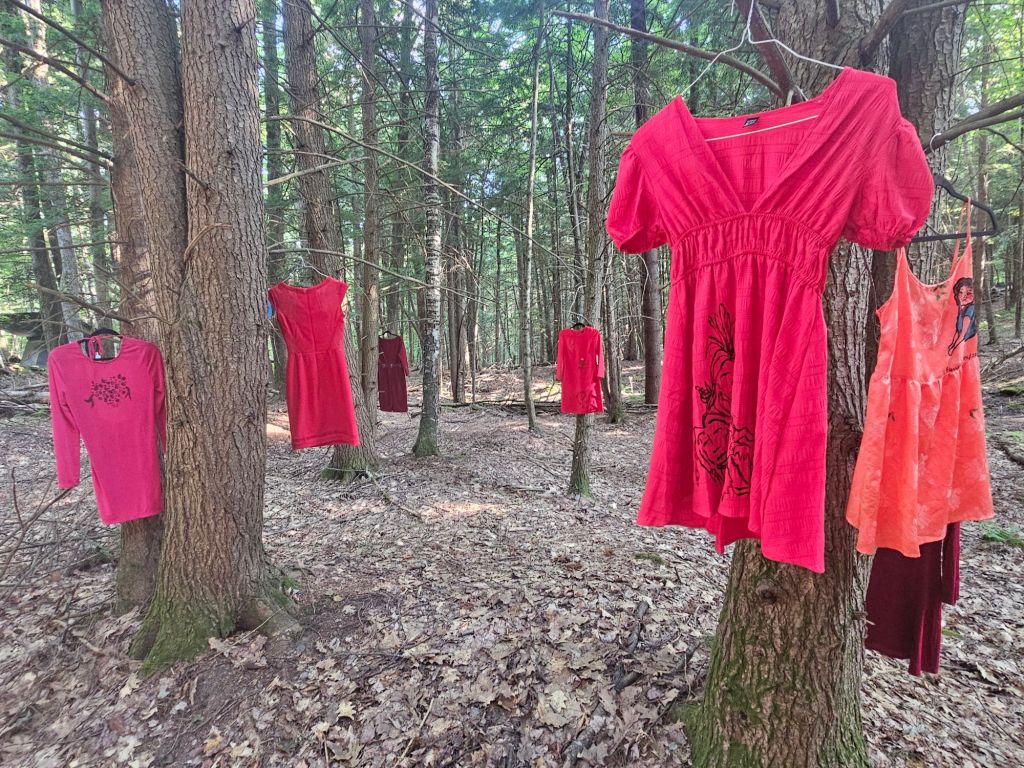
In the creation and installation of miskobagizi, I attempted to create a space that invited curiosity, offered actionable advocacy, and, moreover, encouraged commitment to the movement. In honor of 15 years of the REDress Project, I handpainted 15 red garments which I community sourced. These were hung in a small grove at the Firefly site. After these dresses hung for 2 days, I set-up an advocacy table with contextualizing history, relevant statistics, and effective action items for allies. Finally, I wanted to offer committed allies gifts: I designed 2 sticker series for committed allies; similarly, my sister created 51 deerhide bracelets to signify the 56.1% of Turtle Island women who experience sexual violence. We ask that allies take this gifts as reminders of their intention to advance advocacy for MMIWG2S.
Ultimately, miskobagizi allowed me to interrogate how gendered violence renders Indigenous women hypervisible in spectacle and invisible in justice systems—and how art might trouble these frames. Rather than replicate the red dress movement exactly, I attempted to render “error” aesthetically productive: my hope is the dresses create a visual dissonance that invites viewers into discomfort, not consumption. This project allowed me to reflect on personal and collective memory, the ethics of witnessing, and the political weight of making space for what is missing without claiming to represent it. I hope miskobagizi resists closure, instead asserting a land-based, relational response to grief—where mourning is not a private act but a public call to remain in relation. I hope this work demonstrates how Indigenous women’s visual art can mobilize absence and aesthetic “failure” to foreground survivance, sovereignty, and kinship beyond representation, inviting viewers to confront both presence and loss as active, entangled forces.
Keywords: Indigenous feminism, violence, guerilla art, red dress movement, community arts, autoethnography

Chi-Miigwech (Acknowledgments)
This installation was made possible by the Firefly Creativity Art Grant and the generous, caring Firefly Art Core team. I hope to do more work with you in the future. Chi-Miigwech for making so much space for Indigenous artists at Firefly.
Several people were integral to this project. Scott Arnold LaTour provided early inspiration and guidance. Samantha Eddy was an amazing contributor. Michael Mirabile, Ashlie McCall, and Matt Brightman provided installation help and site clearing. Finally, Scott “Dox” Docherty assisted me at every stage of the process, including walking me through the grant system, helping me strategize the physical installation, and transporting all materials to the physical site.
And finally, Chi-Miigwech to my Indigenous community members with whom I have shared grief, joy, and, above all, relentless hope for unfailing justice.
 miskobagizi